Cookie settings
We use our own and third-party cookies in order to offer our services, display videos, obtain statistics and offer personalized advertising.
For more information, please read our cookies policy.
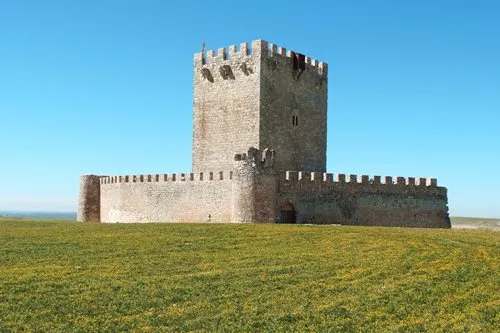
The capital of Castilla y León boasts a rich historical heritage as a result of its past as the capital of the Spanish Empire, as the Spanish kings of the 16th century saw in Valladolid an excellent location for defensive or communication purposes. Regarding its past, it contains numerous castles of unique style that historians considered as exclusively Vallisoletan.
Throughout the province, there are archaeological sites where remains of the various pre-Roman peoples that occupied Valladolid have been found; and many of its towns like Medina del Campo or Peñafiel still preserve the medieval essence through their castles and walls. In the case of Medina del Campo, the most notable place is the castle of the Mota, an excellently preserved artillery park and the best in Europe during the reign of the Catholic Monarchs. Also, Medina del Campo was the place where Queen Isabel la Católica dictated her will on 12 October 1504 and where she would die a month later. There lies the Royal Testament Palace, which retains intact the room where the queen died.
Peñafiel is another Vallisoletan town where the Middle Ages can still be felt. It boasts, along with the town of Simancas, an excellently preserved castle and a museum dedicated to wine.
Medina de Rioseco stands out for its churches and the so-called Canal de Castilla, a 19th-century hydraulic work. It is possible to navigate through the canal to admire the excellent natural route it constitutes. In Olmedo stands the 11th-century wall, of which only part is preserved. In it, we can still appreciate the village arch and the arch of San Miguel, two of the different entrance gates to Olmedo that existed during the Middle Ages. On the other hand, the church of San Andrés and the church of San Miguel are two architectural gems of the 13th century that, of Romanesque and Gothic-Mudejar style respectively, can be visited in Olmedo.
In the region, we can find temples of all architectural styles, from pre-Romanesque to baroque. In the capital, we can admire the church of San Pablo or the cathedral of Valladolid; and various temples like the church of Nuestra Señora de la Anunciada in Urueña.
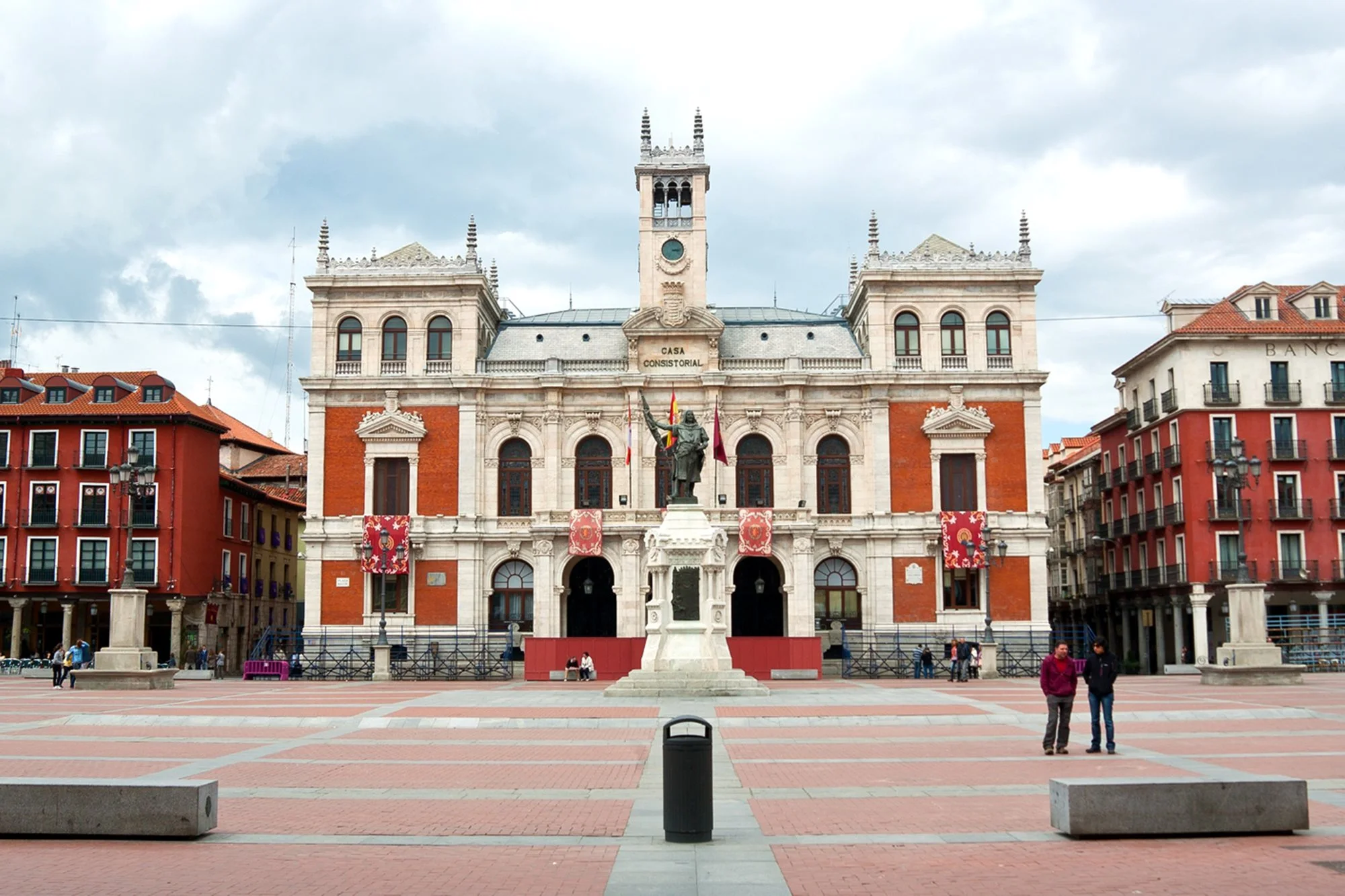
Among the sites to visit in the capital are, among others, the Main Square which, designed by Francisco de Salamanca in the 16th century, is the meeting place for the people of Valladolid and one of the finest examples of this type of urban architecture in Spain. The National Sculpture Museum is also located in Valladolid and houses one of the most important sculptural collections in Europe.
In Vallisoletan cuisine, roasted lamb and Castilian soup are highlights, alongside sweets like the mantecados from Portillo. Ribera del Duero wines can also be enjoyed in Valladolid.
One of the aspects that make Valladolid unique is its Semana Santa, internationally renowned just like those of Zamora or Salamanca.
Administrative capital of Castile and León, the city of Valladolid stands out for a past in which it was the capital of an empire and a global reference point.

Book your hotel