Cookie settings
We use our own and third-party cookies in order to offer our services, display videos, obtain statistics and offer personalized advertising.
For more information, please read our cookies policy.
The province of Zamora is famous for having the best examples of Romanesque architecture in the whole country. Both the Holy Week in its capital and in Bercianos de Aliste are among the most impressive in Spain.
The capital of Zamora sits on a hill surrounded by the Duero River, which made it a perfect strategic location. Evidence of this are its castle and its walls. The Stone Bridge, which was part of an ancient Roman road and dates back to the Middle Ages, is also one of Zamora's most iconic monuments.
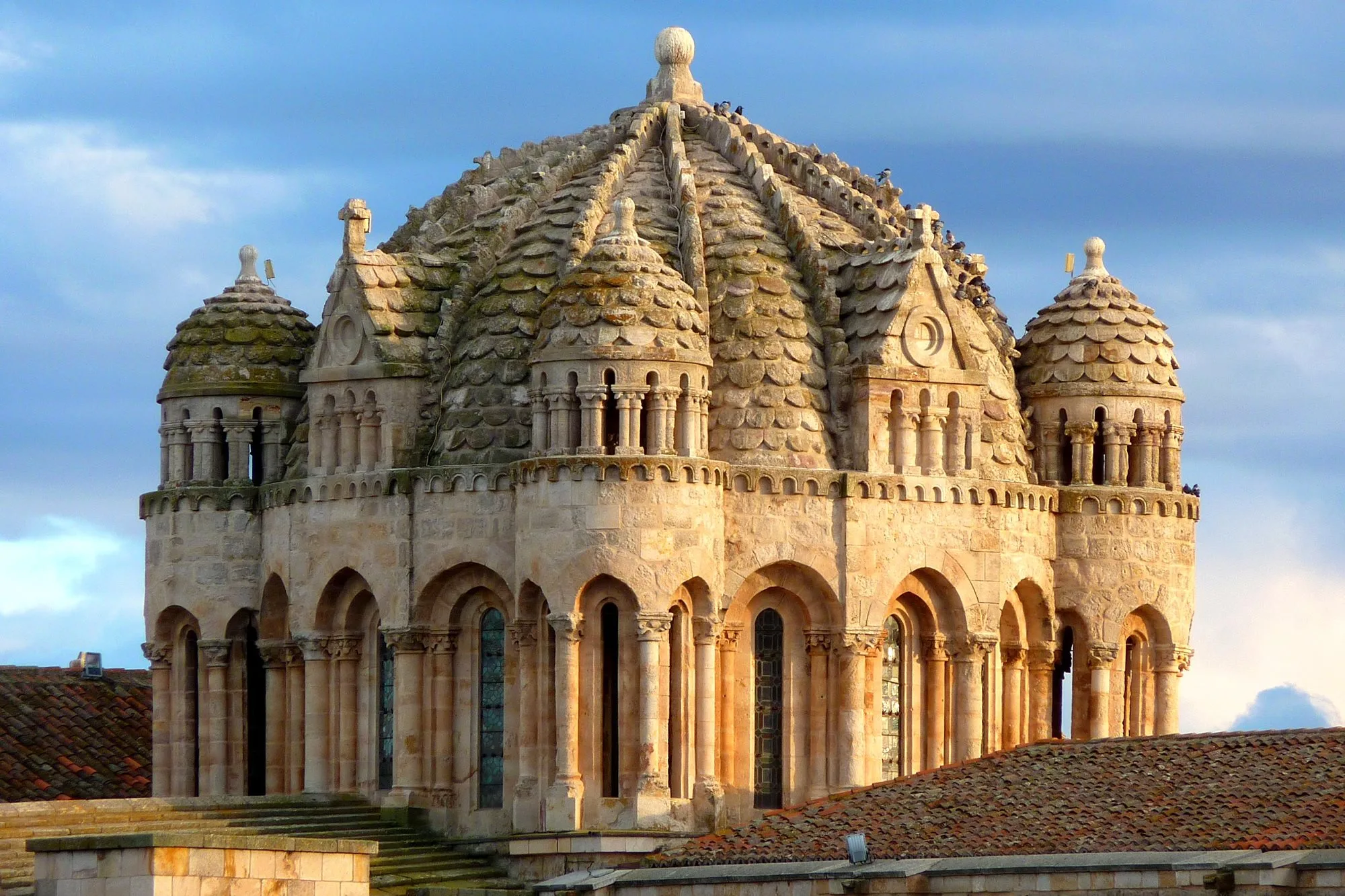
The Cathedral of Zamora, famous for its dome and located at the highest point in the city, along with the Church of Santa María la Nueva or Santiago el Viejo are some of the many Romanesque jewels of the capital. The Church of Santa María Magdalena has a great collection of Romanesque sculptural decoration; and those of Santo Tomé and San Cipriano, located in the old town of the capital of Zamora, are among the most beautiful and oldest in the province.
San Pedro de la Nave is one of the most important churches in Zamora for being one of the first Christian temples built. It is located 12 kilometres from the capital, in the town of El Campillo.
The town of Toro boasts a magnificent historic-artistic ensemble that preserves the city's medieval essence. Its alcazar or the Church of Santa María la Mayor are some of the places that make up its historical and artistic heritage. Toro is also famous for its excellent "Mudejar Romanesque" heritage, in which the churches of San Pedro del Olmo or the Santo Sepulcro stand out. Moreover, Toro is famous for being the city that consecrated Isabel and Fernando, the Catholic Monarchs, on the throne.
Benavente, north of the capital of Zamora, is another town notable for the beauty of its surroundings and its heritage. There we can see the remains of the Monastery of Santa María de Moreruela.
The Arribes del Duero Natural Park is one of the most beautiful natural spaces in Spain. Its microclimate allows for the existence of various animal and plant species typical of the Mediterranean area. The province also houses the largest natural lake on the Iberian Peninsula: Lake Sanabria. In Puebla de Sanabria, near the lake, there is the Church of Nuestra Señora de Azogue, another of Zamora's Romanesque marvels.
In the province of Zamora, you can enjoy delicious dishes such as Zamora-style rice, dos y pingada, and the delicious Aliste beef; as well as desserts like almond custard.
Very close to Portugal and right in the mid-course of the Duero, lies Zamora. A Castilian-Leonese city that connects Galicia with Madrid and the Portuguese territory with the Spanish.

Book your hotel