Cookie settings
We use our own and third-party cookies in order to offer our services, display videos, obtain statistics and offer personalized advertising.
For more information, please read our cookies policy.
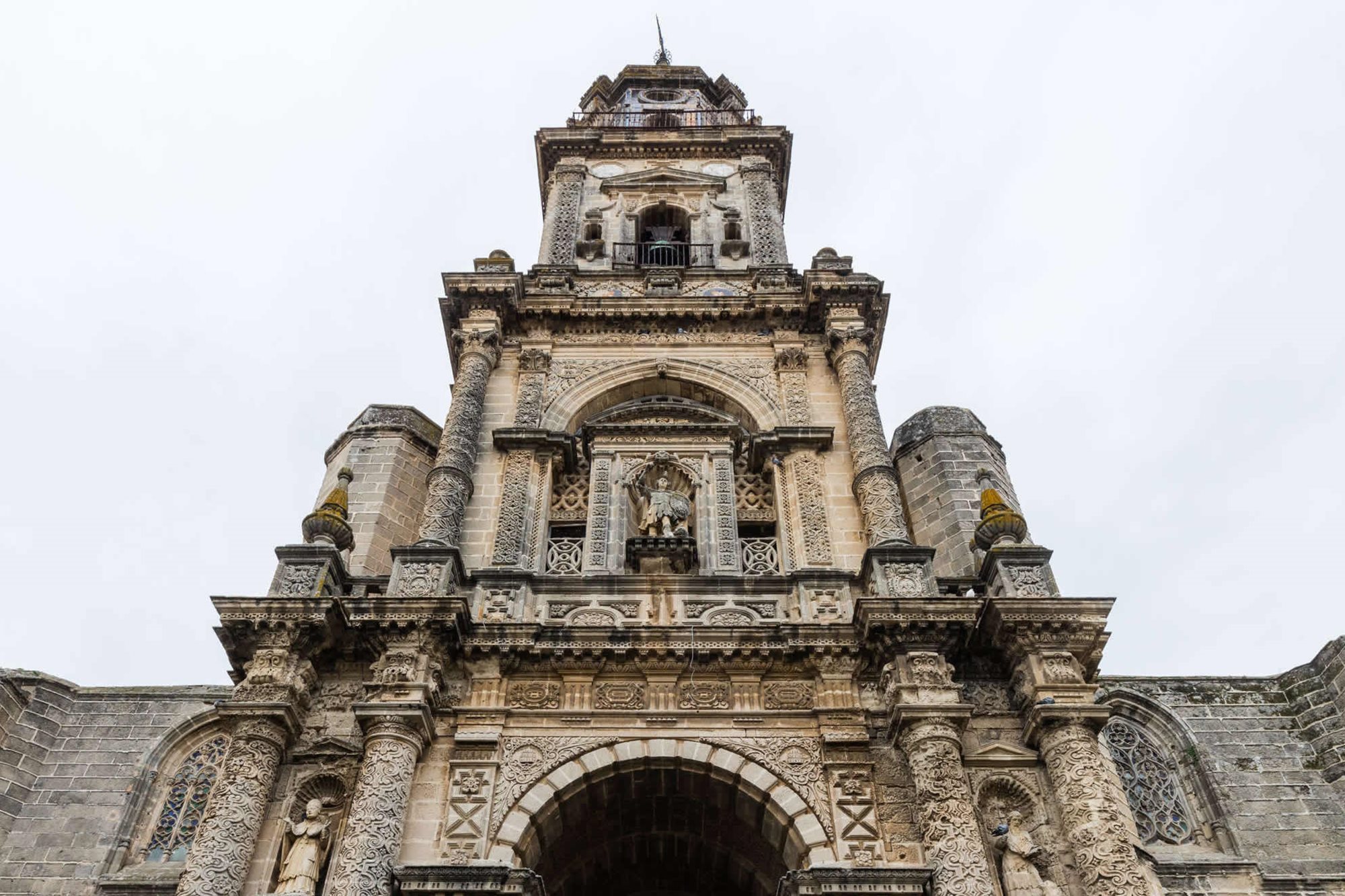
The architecture of the Church of San Miguel stands out for its hybrid and exceptional character. Here, the Jerez Gothic is combined with the Renaissance and Baroque styles.
Great masters such as Francisco Rodríguez, Diego de Riaño, and later Hernán Ruiz II “El Joven” (1564 – 1568) were involved in the Church of San Miguel in Jerez de la Frontera. The magnificent Sacristy, built up to the entablature by Martín de Gaínza, who was the chief architect of the Seville archdiocese and worked on the Seville Cathedral, mainly in its Royal Chapel, is attributed to the latter. The author of the design of this temple in the mid-15th century seems to have been Juan Normán, who was the chief master of the Seville Cathedral (1454 – 1478). His authorship is deduced because he was the only one capable of constructing a similar church in Lower Andalusia.
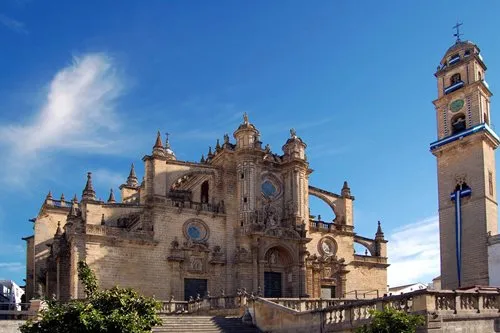
On its exterior, there are three facades, two of which are Gothic: the one of the Gospel (1515) and the one corresponding to the Epistle side. The impressive main facade is the work of the Jerez architect Diego Moreno Meléndez. It was designed with the concept of a tower-facade at the foot of the temple (1672 – 1701). It was built in a Sevillian Baroque style similar to that of this city by Leonardo de Figueroa. Both masters collaborated on the first level that gives access to the church, framed by double columns with niches in the intercolumniation. The access is through a monumental triumphal arch of a half-point framed by the aforementioned double columns. Three other levels rise above the first. The last one is octagonal and is crowned by an outstanding blue and white tile spire. Overall, the profuse decoration of its pilasters and columns turns the facade into a very original work within the fullness of the Baroque.
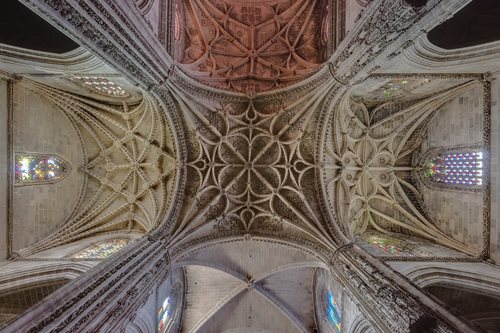
The plan of the Church of San Miguel is rectangular and influenced by the Seville Cathedral. It is divided into three naves by means of clustered pillars of florid Gothic style. The canopies of the pillars are of great variety. These pillars have Portuguese influence, reminiscent of the church of the Jerónimos Monastery in Belem in Lisbon. In fact, many Portuguese masters were in Jerez at that time. The closer ceilings to the main chapel or the apse are more elaborately ribbed, while those approaching more closely to the foot of the temple are simpler. Its transept stands out in height, but not in plan.
Inside, the main altarpiece, designed by Juan Martínez Montañés, stands out. It is a work that exemplifies the maturity of the Sevillian school of sculpture of the first half of the 17th century. The structure of the altarpiece and its images constitute a transition from Mannerism to Baroque. It was continued by José de Arce between 1641 and 1655.
Among the other works of art that can be seen in the interior of this church, the Holy Crucifix of Health attributed to José de Arce stands out. Also, the tabernacle of the Chapel of the Holy Sacrament (18th century) is associated with Andrés Benítez, a Jerez assembler. Another interesting piece is the processional monstrance crafted by Juan Laureano de Pina (17th century).
The Chapel of Socorro is special, where the techniques of the late Gothic are combined with those of the Renaissance style. It was carried out by Pedro Fernández de la Zarza in 1547. The sculptural reliefs of outstanding depth represent the struggle between Good and Evil.
Other chapels are distributed throughout the church. The Chapel of the Holy Sacrament is attributed to Ignacio Díaz based on a probable design by his brother Diego Antonio Díaz. The latter was, for the moment, the architect of the Seville diocese. It was built between 1718 and 1759 in a style similar to that of the main facade associated with the Sevillian Baroque. Its plan is a Greek cross, presenting a central chamfered perimeter with double Corinthian columns. The centre is covered by an octagonal dome with a half-orange shape and lantern, while the rest is covered with barrel vaults.
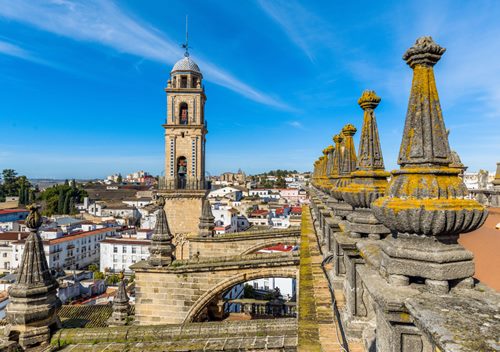
Would you like to visit two essential monumental gems of Jerez de la Frontera? This guided tour is for you. Discover two icons of Jerez’s Gothic and Baroque heritage: the Church of San Miguel and the Cathedral of Jerez, ideal for getting to know the soul of the city.
You will also walk alongside an expert art guide in a pleasant tour filled with architecture, history, and legends that bring Jerez’s heritage to life.
Would you like to visit two essential monumental gems of Jerez de la Frontera? This guided tour is for you. Discover two icons of Jerez’s Gothic and Baroque heritage: the Church of San Miguel and the Cathedral of Jerez, ideal for getting to know the soul of the city.
You will also walk alongside an expert art guide in a pleasant tour filled with architecture, history, and legends that bring Jerez’s heritage to life.
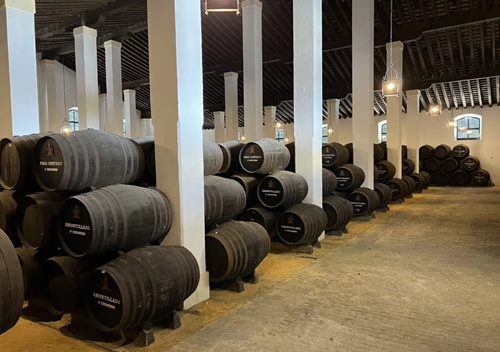
A must-see in Jerez is its wines, which hold a Designation of Origin and are renowned worldwide.
Discover them by visiting a traditional winery in this Cádiz city, such as Cayetano del Pino. With a guide from the establishment, you will explore all the winemaking processes of Jerez wines.
At the end of the tour, you will taste two types of wine, 100% produced in the winery.
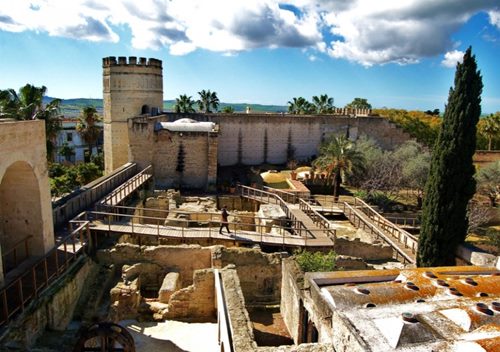
Discover the historic quarter and the Alcázar of Jerez de la Frontera on a two-hour tour.
Accompanied by a tour guide and heritage interpreter, you will marvel at the palace houses and squares you will encounter along the way.
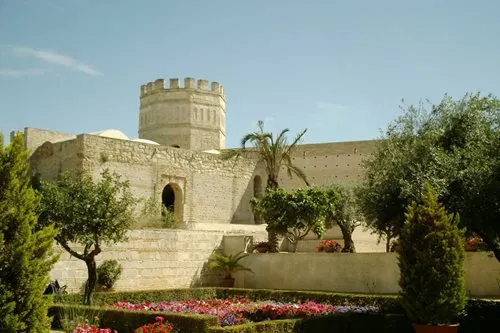
You will end up at the Alcázar of Jerez, a marvel of Almohad defensive architecture, unique in Spain.

Address
Plaza de San Miguel, s/n. 11403 Jerez de la Frontera (Cádiz)Opening times
Prices
If you see any mistakes or want to add anything to this information, please contact us.
Would you like to visit two essential monumental gems of Jerez de la Frontera? This guided tour is for you. Discover two icons of Jerez’s Gothic and Baroque heritage: the Church of San Miguel and the Cathedral of Jerez, ideal for getting to know the soul of the city.
You will also walk alongside an expert art guide in a pleasant tour filled with architecture, history, and legends that bring Jerez’s heritage to life.
Would you like to visit two essential monumental gems of Jerez de la Frontera? This guided tour is for you. Discover two icons of Jerez’s Gothic and Baroque heritage: the Church of San Miguel and the Cathedral of Jerez, ideal for getting to know the soul of the city.
You will also walk alongside an expert art guide in a pleasant tour filled with architecture, history, and legends that bring Jerez’s heritage to life.
A must-see in Jerez is its wines, which hold a Designation of Origin and are renowned worldwide.
Discover them by visiting a traditional winery in this Cádiz city, such as Cayetano del Pino. With a guide from the establishment, you will explore all the winemaking processes of Jerez wines.
At the end of the tour, you will taste two types of wine, 100% produced in the winery.
Discover the historic quarter and the Alcázar of Jerez de la Frontera on a two-hour tour.
Accompanied by a tour guide and heritage interpreter, you will marvel at the palace houses and squares you will encounter along the way.
You will end up at the Alcázar of Jerez, a marvel of Almohad defensive architecture, unique in Spain.
Would you like to visit two essential monumental gems of Jerez de la Frontera? This guided tour is for you. Discover two icons of Jerez’s Gothic and Baroque heritage: the Church of San Miguel and the Cathedral of Jerez, ideal for getting to know the soul of the city.
You will also walk alongside an expert art guide in a pleasant tour filled with architecture, history, and legends that bring Jerez’s heritage to life.
A must-see in Jerez is its wines, which hold a Designation of Origin and are renowned worldwide.
Discover them by visiting a traditional winery in this Cádiz city, such as Cayetano del Pino. With a guide from the establishment, you will explore all the winemaking processes of Jerez wines.
At the end of the tour, you will taste two types of wine, 100% produced in the winery.
Discover the historic quarter and the Alcázar of Jerez de la Frontera on a two-hour tour.
Accompanied by a tour guide and heritage interpreter, you will marvel at the palace houses and squares you will encounter along the way.
You will end up at the Alcázar of Jerez, a marvel of Almohad defensive architecture, unique in Spain.