Cookie settings
We use our own and third-party cookies in order to offer our services, display videos, obtain statistics and offer personalized advertising.
For more information, please read our cookies policy.
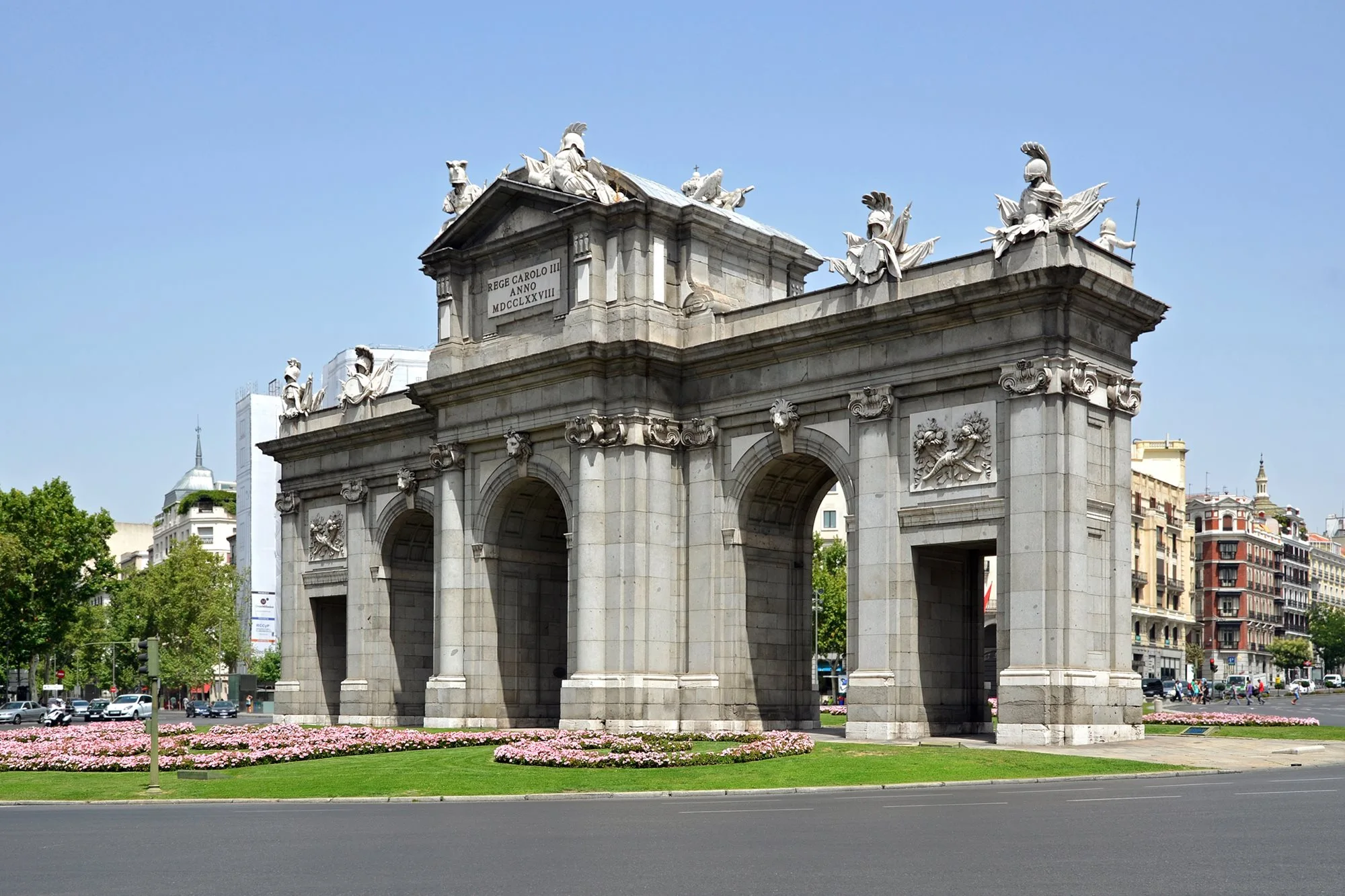
It is one of the most emblematic monuments of Madrid.
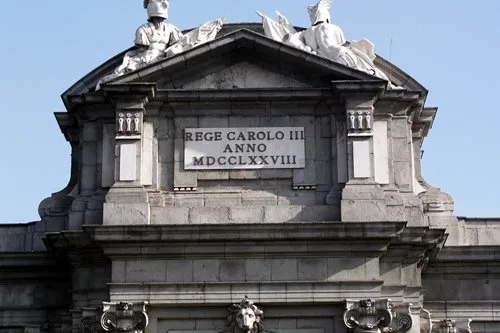
It is located in the Plaza de la Independencia, immersed in a nerve centre of the traffic in Madrid. It commemorates the arrival of Carlos III to the capital city. It is decorated with sculptures, relieves, capitals, a headstone which says “Carlos III. Año 1778” and the coat of arms is held by the fame and the genius. It is built with granite and white stone and is 1.95 metres height. It consists of five openings, three round arches and two trabeated arches.
Over the central arch, there is a curved gable that has another triangular gable inside. This monument presents two different faces. The military trophies and the sculptures of children and the coat of arms that decorates the upper section are Francisco Gutiérrez´ s works, and the rest of the ornamentation belongs to Roberto Michel. In this Savatini´ s work, elements of the international and academic Baroque are mixed in their monumental version, stressing the urban value of a strategic point of the city, due to the relation between the gate and the avenue.
When Carlos III entered to Madrid through the Puerta de Alcalá in 1759, he did not like it and he ordered to pull it down in 1764. The new gate was also ordered to be built by the king Carlos III, who wanted to replace another Baroque gate that had been ordered by Felipe III.
Built: XVIII Century (1769- 1778)
Author: Francisco Sabatini
Style: Neoclassical
Category: Civil
Type: Door
If you're visiting Madrid do not miss an essential tour through its most emblematic places.
This guided tour will takes to you to stroll historical and enchanting Madrid sights such as the Paseo del Retiro, the Barrio de las Letras, the Puerta del Sol and Plaza Mayor.
Without forgetting the Plaza de Oriente, where the Royal Palace and the Almudena Cathedral are located.
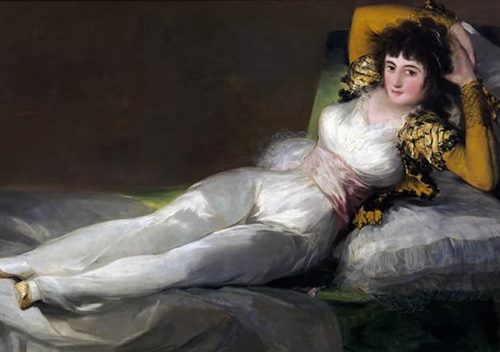
Make the most of your visit to the Prado National Museum. By booking your ticket with an audio guide here, you'll enjoy skip-the-line access to the museum and an app that provides all the details about masterpieces by renowned artists like Goya and Velázquez, as well as great European painters like Rubens.
A perfect option to explore at your own pace one of the largest and most visited art galleries in the world.
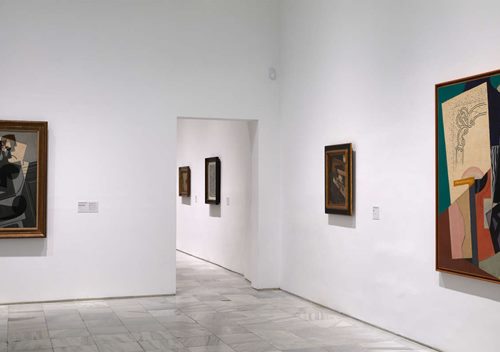
Discover one of Spain's most visited contemporary art museums, the Reina Sofía Museum in Madrid.
Book your ticket with a multilingual audioguide and be captivated by the stories behind masterpieces like Guernica by Pablo Picasso or The Face of the Great Masturbator by Salvador Dalí.
This plan is perfect for exploring the museum at your own pace without missing a single detail.
Address
Plaza de la Independencia, s/n. 28001 MadridIf you see any mistakes or want to add anything to this information, please contact us.
If you're visiting Madrid do not miss an essential tour through its most emblematic places.
This guided tour will takes to you to stroll historical and enchanting Madrid sights such as the Paseo del Retiro, the Barrio de las Letras, the Puerta del Sol and Plaza Mayor.
Without forgetting the Plaza de Oriente, where the Royal Palace and the Almudena Cathedral are located.
Make the most of your visit to the Prado National Museum. By booking your ticket with an audio guide here, you'll enjoy skip-the-line access to the museum and an app that provides all the details about masterpieces by renowned artists like Goya and Velázquez, as well as great European painters like Rubens.
A perfect option to explore at your own pace one of the largest and most visited art galleries in the world.
Discover one of Spain's most visited contemporary art museums, the Reina Sofía Museum in Madrid.
Book your ticket with a multilingual audioguide and be captivated by the stories behind masterpieces like Guernica by Pablo Picasso or The Face of the Great Masturbator by Salvador Dalí.
This plan is perfect for exploring the museum at your own pace without missing a single detail.

Would you like to stroll through the heart of Madrid and taste the best tapas? This is your tour.
By booking, you’ll receive a link to download an exclusive, multilingual app. With it, you’ll explore iconic spots like Plaza Mayor, Mercado de San Miguel, and Puerta del Sol.
Discover renowned venues where you can savor the finest Spanish and Madrid-style tapas, from timeless classics to bold innovations. Immerse yourself in the culinary culture of this vibrant city and its people. You’ll even learn fascinating stories and fun facts about each selected bar.
Don’t miss out on this experience!
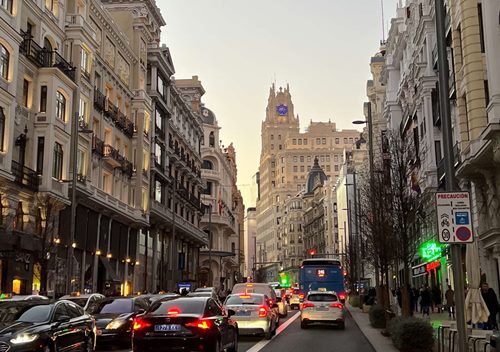
Discover Madrid through its movies with this incredible tour—an original way to explore the city's heritage and culture. You'll learn about Madrid's origins while strolling through film locations and watching their sequences.
Your journey will start at the Royal Palace, passing through the Austrias neighborhood, Plaza Mayor, Sol, and Callao. Along the way, the guide will reveal fascinating anecdotes about Madrid in cinema.
The tour ends on Gran Vía, a backdrop for iconic films, where you'll enjoy a cocktail at the legendary Chicote. Don't just hear about it—experience it yourself!
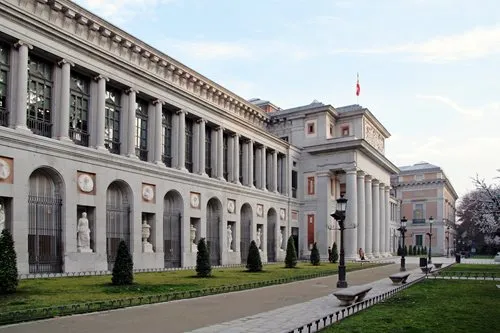
The Prado Museum is considered as one of the most important art galleries in the world.
It has the major Spanish painting collection from the XI and XII Centuries, and most of the greatest painters´ masterpieces such as Velázquez, Goya, El Greco, Tiziano, El Bosco, Rubens.
In total there are approximately more than 9,000 works of art, mainly paintings, and only 1,500 of these paintings are exposed to the public.
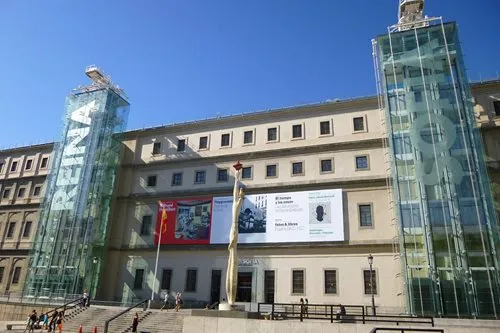
It is a museum of Spanish art from the XX Century. It has headquarters in the old San Carlos Hospital built by Francisco Sabatini, and recently enlarged by the architect Jean Nouvel. It was inaugurated the 10th September 1992 by their Majesties the King and the Queen of Spain Juan Carlos and Sofía.
The works of art exposed in it have constantly been enriched. Its modern art collection is one of the most valued.
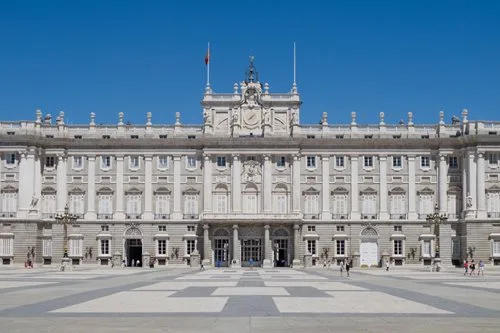
This Palace is a solemn and monumental building whose immense architectonical beauty is enhanced by the gardens that surround it. It is located in Madrid City Centre.
It was built as an order of the king Felipe V on the ruins of a Muslim Castle and later on the ruins of the Alcázar of Madrid that was destroyed in a fire. It is the official residence of His Majesty the King of Spain and is used for official ceremonies.
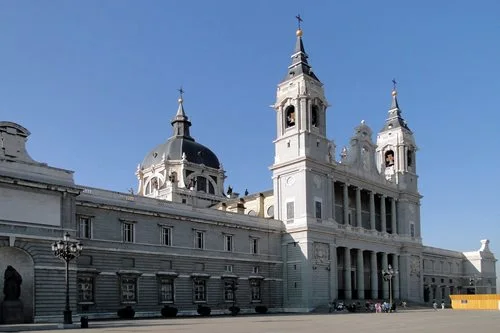
This Cathedral is placed in Madrid city centre, in front of the Royal Palace. The temple joins different styles, such as Neoclassic, Neogothic, Neoromanesque. It was consecrated by the Pope John Paul II, during his fourth visit to Spain, the 15th June 1993.
It has a Latin cross plan of 102 meters length by 73 meters high, and joins different styles, the Neoclassic style outside and Neogothic style inside. It has a transept of 66 meters length, 13 chapels, 3 altars and a great dome of 20 meters of diameter. It was built using stone and granite. The main façade is crowned by four statues that were created by the sculptor Ramón Chaparro, and represent four Spanish saints: San Isidro, Santa María de la Cabeza, Santa Teresa de Jesús and San Fernando. They are made of white stone from Colmenar.
It has a double dome which is Gothic inside and Barroque outside. In said dome the twelve apostles are represented. The image of the Virgin of Almudena, the patron saint of the city, has its own altar in the transept of the right nave. It is placed on the central vaulted niche of a spectacular altarpiece, painted by Juan de Borgoña (at the end of the XV Century and beginning of the XVI Century). This altar piece is composed by eighteen boards with scenes of our God´ s life. Kiko Argüello´s Neobizantine paintings were the last elements added to the Cathedral. They are painted in the apse of the cathedral, and represent scenes of Christ´ s life.
In 1944, a National Contest of Architecture is organised in order to solve the difficult problem of finishing the construction of the Almudena. The architects Fernando Chueca and Calos Sidro won it, leaving the Neogothic elements and linking the tempo with its environment through cloisters with columns, chapels and rooms, in this way, the cathedral would be harmonized with the environment of the Royal Palace which is also Neoclassic.

Book your hotel