Cookie settings
We use our own and third-party cookies in order to offer our services, display videos, obtain statistics and offer personalized advertising.
For more information, please read our cookies policy.
Its floor plan is irregular, and the interior originally featured a layout with different rooms: those mentioned earlier, as well as the salons, oratory, entrance hall, garden, kitchen, and the workhouse. However, the renovations in the last century partially altered this layout.
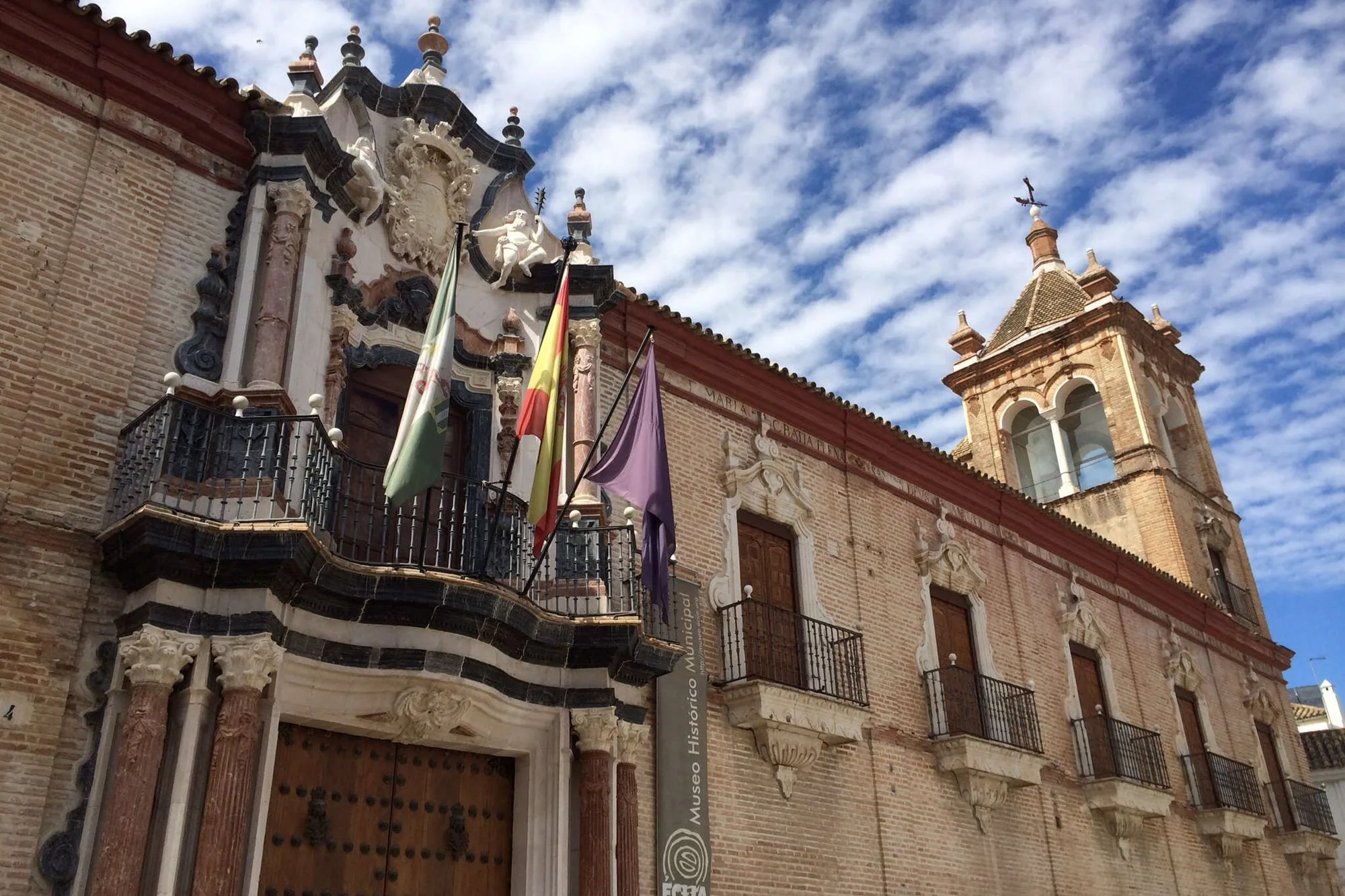
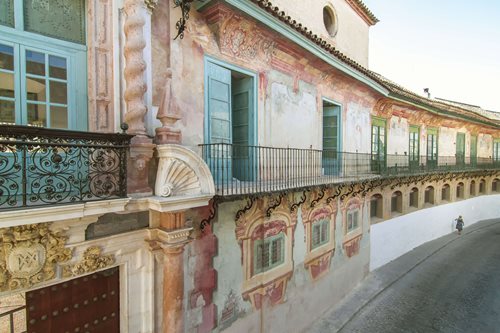
Its monumental main façade was built in brick. The façade is divided into two bodies with great architectural and decorative dynamism, where marbles of various colours were used. The lower section of the façade is the entrance door itself, with a lintel and framed by double Corinthian columns. These columns, resting on greenish marble pedestals, have reddish shafts and white capitals. The mixed-line entablature rests on the columns, dividing the two bodies of the façade: with a green architrave, white frieze, and prominent green cornice. Above the entablature is the concave second body, with the balcony also featuring a mixed-line design.
The balcony is framed by a column, in the same colour scheme as the lower body. The opening of this balcony, with a mixed-line lintel, is framed by elements of great decorative richness. Here again is the green pedestal, upon which rest stipes with Corinthian capitals and an entablature where colours, straight lines, curves, and volutes alternate.
No less important is the finish of the façade with a mixed-line pediment topped with pinnacles, in the centre of which is the Bernuy family crest held by two allegorical figures.
At the ends of the façade are two lookout towers of square plan. Both have two bodies separated by mouldings. The first body features a balcony similar to those on the rest of the façade. The second boasts twin semicircular arches and rectangular openings on each side.
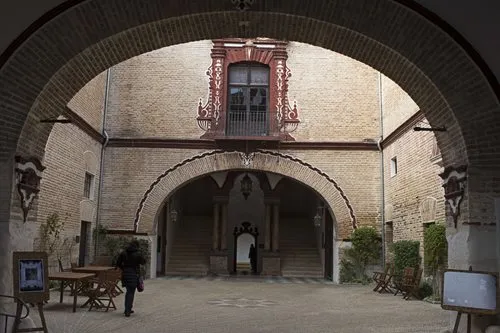
Entry to the building is via a vestibule leading to the courtyard of the coach house, whose entrance has a depressed arch. This arch is made of brick, with tendel markings, and is decorated with hanging ornaments at the keystone and springers.
The courtyard's layout is rectangular. On its right side are the stable blocks with a rectangular plan and three bays. These bays are separated by Tuscan columns and semicircular arches. The stables are covered with groin vaults.
On the left side of the courtyard is the palace's hall, with the old garden behind it.
The courtyard's main side is the highlight, featuring a depressed arch and a balcony with rich decoration above, leading to the staircase. This imperial-style staircase has two ascending flights, converging at a landing from which a single flight rises. The start of the staircase and the ascent to the second floor are preceded by three monumental, trilobed, red arches. These arches are supported by pairs of Tuscan columns resting on pedestals. The staircase hall is covered by a hemispherical dome on pendentives.
Among the rooms surrounding the staircase, the chapel or small oratory of rectangular plan stands out.
Also remarkable is the central courtyard of square plan with arcaded galleries on each side, semicircular below and depressed above. The arches are made of brick with decoration on the corbels, hanging ornaments at the keystone, and spandrels. These rest on Tuscan columns. The upper floor overlooks the courtyard with a metal railing. Around this courtyard are other rooms of the palace, such as bedrooms, dining rooms, and salons. The great hall is noteworthy among these, but all have a lintelled ceiling with wooden beams. To the left of the courtyard is the old workhouse, significantly modified by later renovations.
Address and telephone
Opening times
From 1st October to 30th June:
- Tuesday to Friday, from 10:00 to 13:30 and from 16:30 to 18:30.
- Saturday, from 10:00 to 14:00 and from 17:30 to 20:00.
- Sunday and public holidays, from 10:00 to 15:00.
From 1st July to 30th September:
- Tuesday to Friday, from 10:00 to 14:30.
- Saturday, from 10:00 to 14:00 and from 10:00 to 22:00.
- Sunday and public holidays, from 10:00 to 15:00.
Prices
General rate: €3.
If you see any mistakes or want to add anything to this information, please contact us.
Book your hotel