Cookie settings
We use our own and third-party cookies in order to offer our services, display videos, obtain statistics and offer personalized advertising.
For more information, please read our cookies policy.
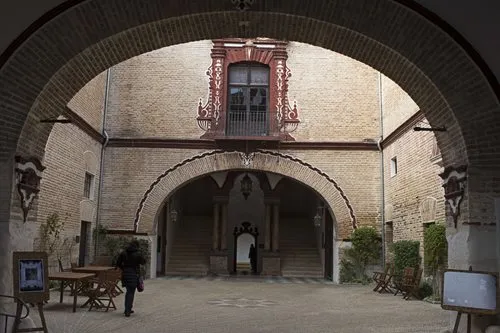
Its floor plan is irregular, and the interior originally featured a layout with different rooms: those mentioned earlier, as well as the salons, oratory, entrance hall, garden, kitchen, and the workhouse. However, the renovations in the last century partially altered this layout.
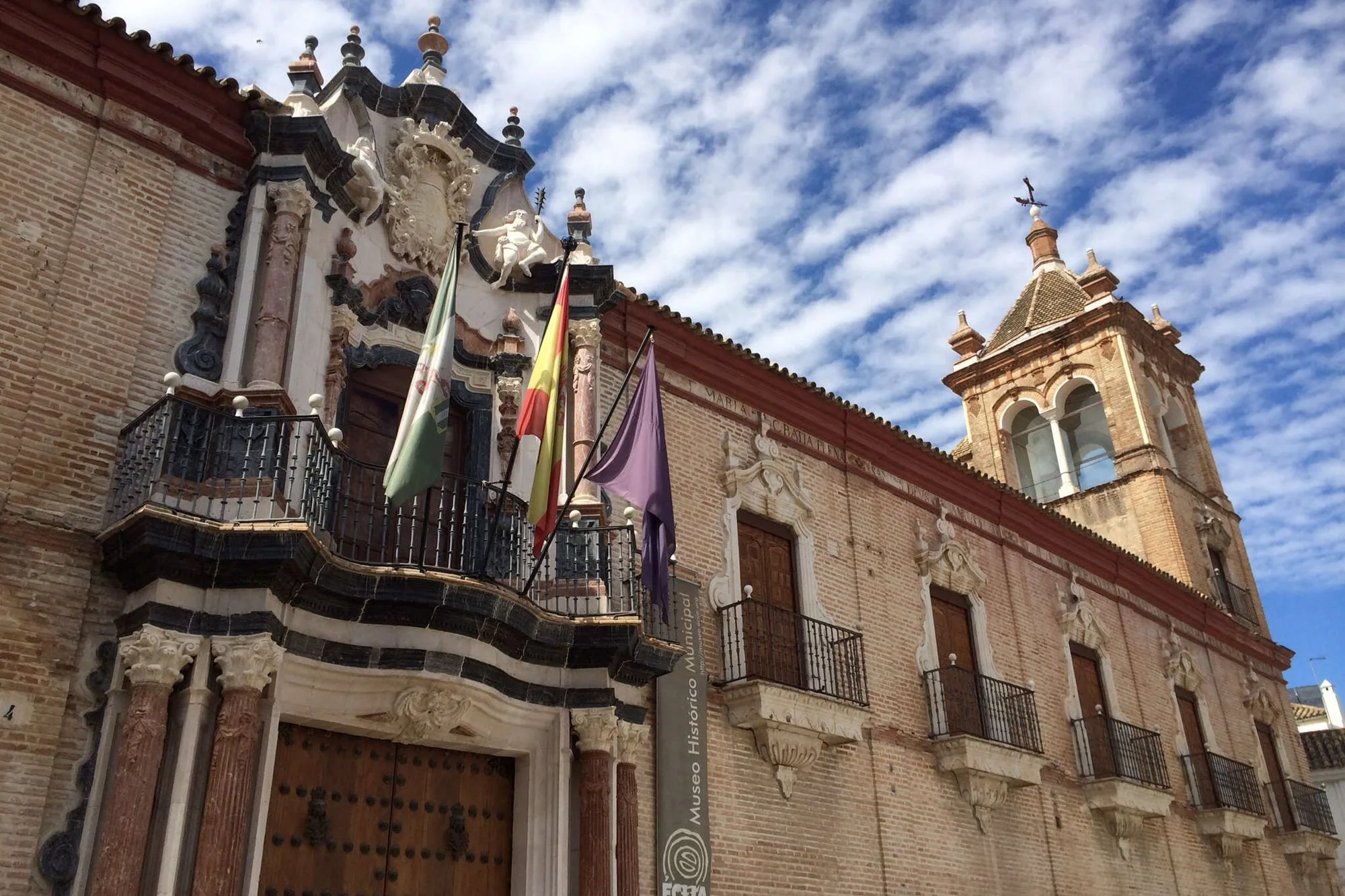
Its monumental main façade was built in brick. The façade is divided into two bodies with great architectural and decorative dynamism, where marbles of various colours were used. The lower section of the façade is the entrance door itself, with a lintel and framed by double Corinthian columns. These columns, resting on greenish marble pedestals, have reddish shafts and white capitals. The mixed-line entablature rests on the columns, dividing the two bodies of the façade: with a green architrave, white frieze, and prominent green cornice. Above the entablature is the concave second body, with the balcony also featuring a mixed-line design.
The balcony is framed by a column, in the same colour scheme as the lower body. The opening of this balcony, with a mixed-line lintel, is framed by elements of great decorative richness. Here again is the green pedestal, upon which rest stipes with Corinthian capitals and an entablature where colours, straight lines, curves, and volutes alternate.
No less important is the finish of the façade with a mixed-line pediment topped with pinnacles, in the centre of which is the Bernuy family crest held by two allegorical figures.
At the ends of the façade are two lookout towers of square plan. Both have two bodies separated by mouldings. The first body features a balcony similar to those on the rest of the façade. The second boasts twin semicircular arches and rectangular openings on each side.
Entry to the building is via a vestibule leading to the courtyard of the coach house, whose entrance has a depressed arch. This arch is made of brick, with tendel markings, and is decorated with hanging ornaments at the keystone and springers.
The courtyard's layout is rectangular. On its right side are the stable blocks with a rectangular plan and three bays. These bays are separated by Tuscan columns and semicircular arches. The stables are covered with groin vaults.
On the left side of the courtyard is the palace's hall, with the old garden behind it.
The courtyard's main side is the highlight, featuring a depressed arch and a balcony with rich decoration above, leading to the staircase. This imperial-style staircase has two ascending flights, converging at a landing from which a single flight rises. The start of the staircase and the ascent to the second floor are preceded by three monumental, trilobed, red arches. These arches are supported by pairs of Tuscan columns resting on pedestals. The staircase hall is covered by a hemispherical dome on pendentives.
Among the rooms surrounding the staircase, the chapel or small oratory of rectangular plan stands out.
Also remarkable is the central courtyard of square plan with arcaded galleries on each side, semicircular below and depressed above. The arches are made of brick with decoration on the corbels, hanging ornaments at the keystone, and spandrels. These rest on Tuscan columns. The upper floor overlooks the courtyard with a metal railing. Around this courtyard are other rooms of the palace, such as bedrooms, dining rooms, and salons. The great hall is noteworthy among these, but all have a lintelled ceiling with wooden beams. To the left of the courtyard is the old workhouse, significantly modified by later renovations.
Address and telephone
Opening times
From 1st October to 30th June:
- Tuesday to Friday, from 10:00 to 13:30 and from 16:30 to 18:30.
- Saturday, from 10:00 to 14:00 and from 17:30 to 20:00.
- Sunday and public holidays, from 10:00 to 15:00.
From 1st July to 30th September:
- Tuesday to Friday, from 10:00 to 14:30.
- Saturday, from 10:00 to 14:00 and from 10:00 to 22:00.
- Sunday and public holidays, from 10:00 to 15:00.
Prices
General rate: €3.
If you see any mistakes or want to add anything to this information, please contact us.
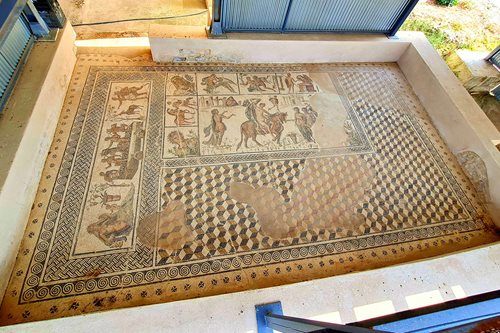
The archaeological site Plaza de Armas (or Alcázar of Écija) is located on one of the highest parts of the city. Its area covers 5,480 square metres. It represents the history of Écija, as different levels can be observed according to its successive occupations from its origins to the present day.
The oldest remains documented date from the Late Bronze Age, whose foundations would have had oval and circular huts, as well as some rectangular structure.
Subsequently, came the occupation by the Turdetani, whose urban planning at that time consisted of paved streets. It wasn't until the Roman era that Écija was reoccupied. During this period, the Iberian structures were demolished and the materials reused for the new city. Several domestic structures with Roman mosaics of great value were documented in the plaza de armas.
In the 11th century, the Almoravids demolished what had been built to erect the alcázar of Istiya. Two centuries later, the alcázar passed into Christian hands following the conquest of the city in 1240, and the plaza was restructured. In the 16th and 17th centuries, it was abandoned. It became a horse riding school in the 18th century, colloquially known among the people of Écija as the Picadero neighbourhood.
The local Town Hall undertook recovery works in 1999 with various excavations, which continue today.
Notable within its interior is a Turdetani building that was used for worship. It houses several Roman rooms with rich mosaic decoration, mural painting, and marble flooring. Standing out is the mosaic of The Loves of Zeus, which measures 40 square metres and is in excellent condition. Its discovery was listed as one of the top ten discoveries of 2015 by National Geographic The remains of the Muslim alcázar's wall are also preserved, from which the entire city of Écija can be viewed.
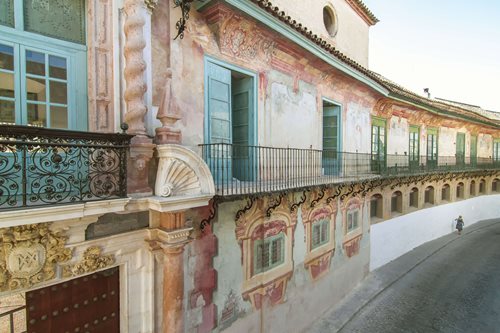
The Palace of the Marquises of Peñaflor and Cortes de Graena, also known as the Palace of the Long Balconies, is one of the finest examples of Écija's Baroque architecture.
It is a Baroque mansion remodelled from a previous Renaissance building. For this refurbishment, several adjoining houses were added to the original building, resulting in the current palace in 1775.
The most stunning aspect when encountering its curved façade, over sixty metres long, are its mural paintings. These were the work of Antonio Fernández, who painted them in fresco between 1764 and 1765, depicting trompe-l'oeils of architectural elements, figures, false windows that enhance the monumentality and colour of the palace. Of course, a continuous balcony along the entire façade, created by Pedro Calderón in 1762, is also notable.
A beautiful Baroque doorway provides access to the building (1726 – 1727). It was crafted in stone with Doric columns framing the entrance opening and Solomonic ones on the upper balcony, topped by the heraldry of the families that built this building: Barradas, Henestrosa, Bazán, and Fernández de Córdoba. At an angle and above the doorway lies an imposing viewpoint offering incredible views of the city of Écija.
Beyond the entrance doorway lies the hangar and the stables courtyard. Notably, the entrance to these stables, created by Juan Antonio Blanco in 1762, stands out. The interior of the stables is divided into three sections covered by cross vaults supported by robust columns. A grand staircase starting from the hangar is also noteworthy due to the proportions of its structure and decoration. On its walls is the altarpiece of the Virgin of the Rosary, richly embellished with plasterwork and paintings, by Fray Antonio de Molino (1767). Equally important is the domed ceiling that covers the staircase.
The ground floor of the palace features several courtyards, with the main one standing out. This courtyard is highlighted by two superimposed floors with arcades of semicircular arches. These white galleries contrast beautifully with the stone fountain located in the courtyard’s centre. Surrounding the courtyard are lounges covered with interesting wooden ceilings.
After several years of being in ruins and closed, the Palace of Peñaflor is now open to visitors thanks to restoration efforts; though currently only partially accessible until it can be fully opened.
Book your hotel