Cookie settings
We use our own and third-party cookies in order to offer our services, display videos, obtain statistics and offer personalized advertising.
For more information, please read our cookies policy.
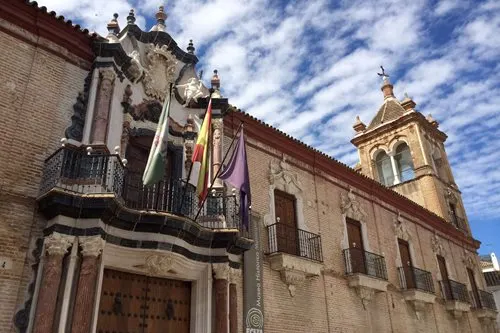
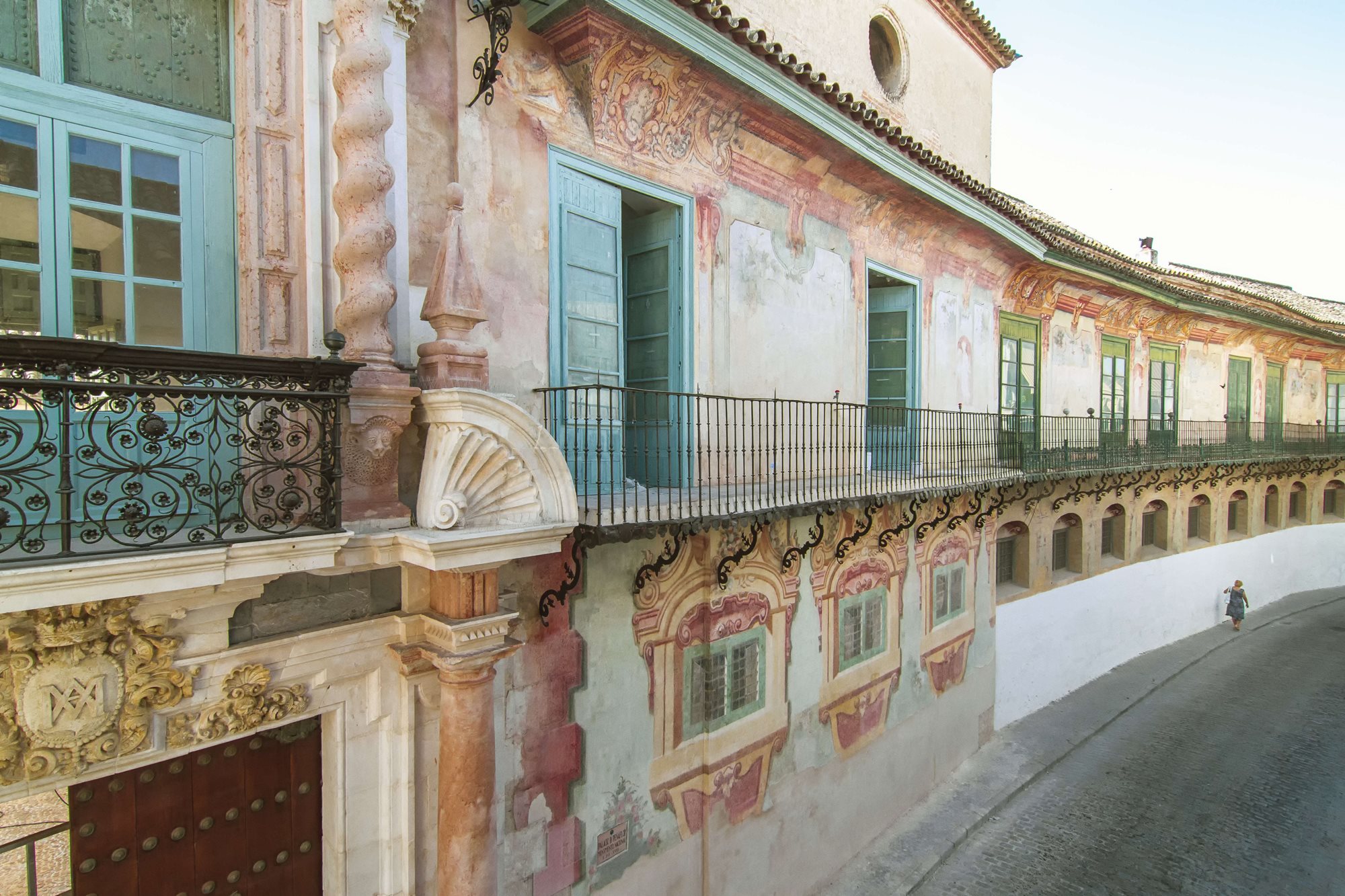
The Palace of the Marquises of Peñaflor and Cortes de Graena, also known as the Palace of the Long Balconies, is one of the finest examples of Écija's Baroque architecture.
It is a Baroque mansion remodelled from a previous Renaissance building. For this refurbishment, several adjoining houses were added to the original building, resulting in the current palace in 1775.
The most stunning aspect when encountering its curved façade, over sixty metres long, are its mural paintings. These were the work of Antonio Fernández, who painted them in fresco between 1764 and 1765, depicting trompe-l'oeils of architectural elements, figures, false windows that enhance the monumentality and colour of the palace. Of course, a continuous balcony along the entire façade, created by Pedro Calderón in 1762, is also notable.
A beautiful Baroque doorway provides access to the building (1726 – 1727). It was crafted in stone with Doric columns framing the entrance opening and Solomonic ones on the upper balcony, topped by the heraldry of the families that built this building: Barradas, Henestrosa, Bazán, and Fernández de Córdoba. At an angle and above the doorway lies an imposing viewpoint offering incredible views of the city of Écija.
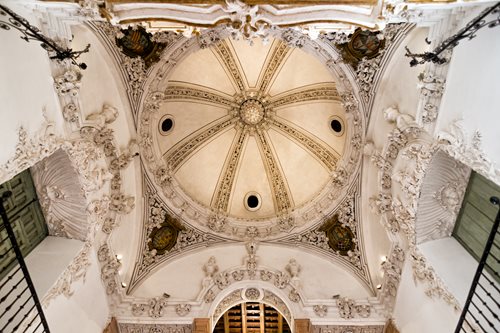
Beyond the entrance doorway lies the hangar and the stables courtyard. Notably, the entrance to these stables, created by Juan Antonio Blanco in 1762, stands out. The interior of the stables is divided into three sections covered by cross vaults supported by robust columns. A grand staircase starting from the hangar is also noteworthy due to the proportions of its structure and decoration. On its walls is the altarpiece of the Virgin of the Rosary, richly embellished with plasterwork and paintings, by Fray Antonio de Molino (1767). Equally important is the domed ceiling that covers the staircase.
The ground floor of the palace features several courtyards, with the main one standing out. This courtyard is highlighted by two superimposed floors with arcades of semicircular arches. These white galleries contrast beautifully with the stone fountain located in the courtyard’s centre. Surrounding the courtyard are lounges covered with interesting wooden ceilings.
After several years of being in ruins and closed, the Palace of Peñaflor is now open to visitors thanks to restoration efforts; though currently only partially accessible until it can be fully opened.
Built: 18th Century.
Style: Baroque Andalusian
Category: Civil
Type: Mansion-house
Address and telephone
Opening times
If you see any mistakes or want to add anything to this information, please contact us.