Cookie settings
We use our own and third-party cookies in order to offer our services, display videos, obtain statistics and offer personalized advertising.
For more information, please read our cookies policy.
The oldest part of this building is the Patio de los Naranjos attached to the left wall, as it could have been part of the ablutions courtyard of the Almohad mosque that existed previously (demolished in 1424 to build the church). This courtyard has a colonnaded gallery on two of its sides, with marble or granite columns as supports. In turn, these columns have cimacios as a finish. One of them preserves a Visigothic inscription, being reused in the Muslim period. The north gallery features seven arches with the central one being larger and higher; while the lateral ones are pointed horseshoe arches. The arches of the East gallery are also higher and all framed with an alfiz. It is deduced that, although these arches were from the Islamic period, they were remodelled during the Christian construction of the 15th century.
From the same period dates the Chapel of the Apostles on the North side of the church. Its roof is an octagonal vault supported on squinches at its angles. The east wall facade presents on its exterior a simple pointed archivolt, framed by an alfiz and topped with a cornice of scroll modillions.
The Gothic church has a hall plan, embedding the transept within. It has three naves divided into five sections. The apse is flat, presenting two sections. In the side naves, chapels are attached between the buttresses. It has three access portals. The one located at the west was made in the 19th century in neo-Gothic style. The side portal was the work of Antonio Chamorro, with lines by Antonio de Figueroa y Ruiz in 1775. The one that opens onto the Patio de los Naranjos, the one on the left side, is not finished but is also from the 18th century.
The naves are separated by pointed arches supported on polygonal or almost circular pillars; depending on their location, either near the west or the apse of the church. The almost circular section pillars have many shafts of different thickness and height. Light penetrates through the stained glass of the pointed Gothic windows of the second body of the central nave.
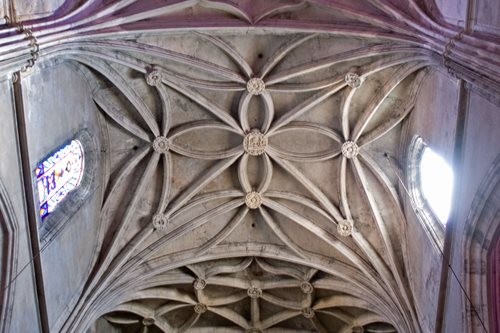
The decoration contrasts between the ribbed vaults of the three naves, as the ones in the west zone of the temple are sextipartite and those at the apse zone are star-shaped. The dome is located in the centre of the transept, specifically in the fourth section of the central nave. It is higher in height than the entire set of vaults covering the central nave. Its complex ribs and its pointed openings with stained glass accentuate the chiaroscuro in the network of nerves. In the keystones and walls on which the dome rests, it is decorated with saints, angels and mythological characters.
The side chapels are also covered with star-shaped Gothic ribbed vaults. Other chapels are covered with crossed ribs forming coffers, showing a clear transition to the Renaissance. This type of roof is also found in the sacristy.
According to the sense of a clock, from the rear of the Gospel nave, the side chapels are in the following order: Baptismal chapel, Tabernacle Chapel, access door from the Patio de los Naranjos, the Chapel of the Christ of Miracles and the Chapel of the Virgin of Grace, whose plan is eight-sided and covered with a dome topped with a lantern. The main chapel is at the apse of the central nave, followed by the main sacristy in the Epistle nave. They are followed by the Chapel of the Virgin of Antigua, which joins the Calvary Chapel. Next, are the chapels of San José, the access door to the Epistle nave, the Chapel of the Virgin of the Rosary, the Virgin of Peace and the of the Incarnation (also known as the Chapel of the Barreda).
In the penultimate section of the central nave is the choir. Its walls feature elements from the Renaissance and Mannerist period. The crujía or sacra way connects the choir with the presbytery.
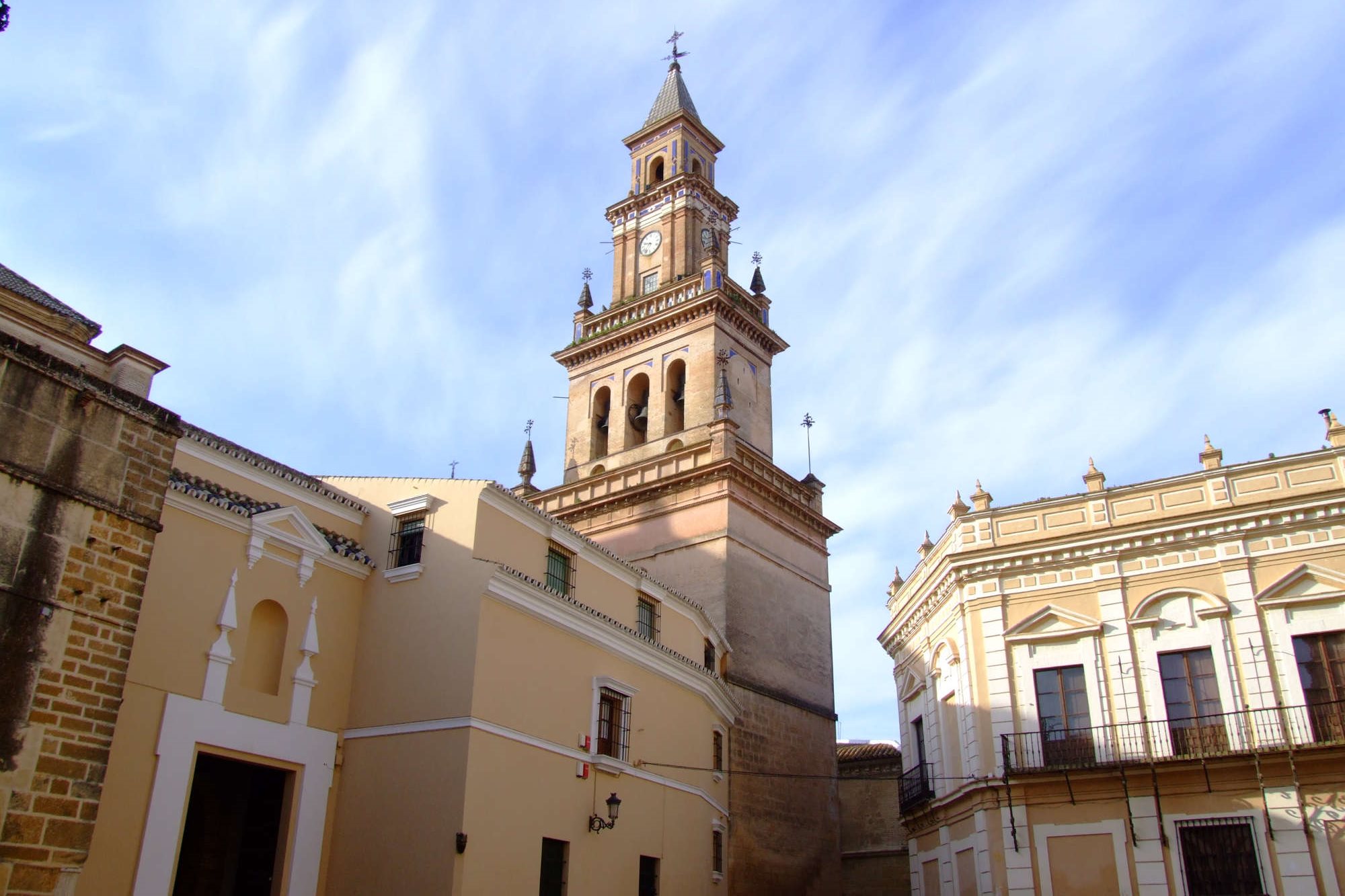
At the rear of the church is the tower, between the Patio de los Naranjos and the Baptismal Chapel on the Gospel side. It is divided into four sections, with the first three being rectangular and the fourth being square. The first section looks solid with no openings, topped with an entablature, on which rests a parapet with corner pillars and pyramidal finishes. The second section is smaller but has five semi-circular openings, framed with an alfiz and tiles in the spandrels. Three openings face the Patio de los Naranjos, two on the opposite side, and one facing the church. The third section is surrounded by an openwork parapet with rhomboid shapes, similar to the one in the first section. A rectangular structure houses a lintelled opening with the clock face flanked by paired pilasters on the long side and simple pilasters on the short one. On these pilasters rests the entablature that acts as a support for the fourth section. This last section, square, rises with semi-circular arches slightly raised on each of its sides. These arches are flanked by pilasters decorated with tiles. As a finish, it has a pyramidal spire with blue and white tiles.
Address and telephone
Opening times
If you see any mistakes or want to add anything to this information, please contact us.
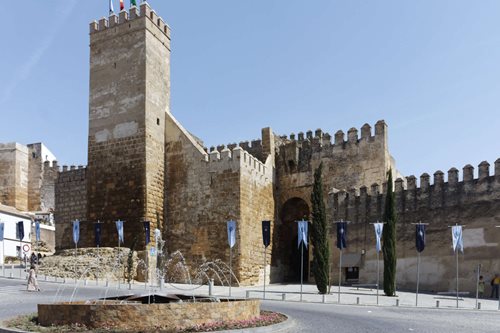
The Alcázar of the Puerta de Sevilla, also known as the Lower Alcázar in Carmona, is named after the Puerta de Sevilla. It is a defensive bastion located in the western part of the city.
Archaeological remains were found dating from the period between the 14th and 12th centuries BC, but its origin is from the 9th century BC. This monument preserves the mark of the history of Carmona and the West, in which this city has been a participant. The stones of the Puerta de Sevilla bear the legacy of the Phoenicians, Carthaginians, Romans, Muslims, and Christians.
In the original tower of the 8th century BC, the Carthaginians designed their first quadrangular floor plans, of robustness and firmness to face the Romans. In Roman times, with Augustus, the structure was reinforced and reformed with several doors that still stand today. A temple was even built, of which part of its platform or podium remains today. The Romans continued interventions in this place, especially in the 1st century AD, until making Carmo "the strongest city of Baetica during antiquity," according to Caesar.
With the arrival of the Muslims, this complex also underwent some reforms. A caliphate horseshoe arch was opened in the 10th century and a more external Almohad pointed horseshoe arch in the 12th century. In the 14th century, with the reign of Peter I, the interior of the complex was reformed.
During the second half of the last century, the complex underwent several rehabilitations. In the sixties, it was stripped of the houses that were attached. The last time it was reformed was in 1973, enabling the Lower and Upper Prison Hall, the Tower of Gold, and the Patio of the Cisterns. From the Tower of Gold, incredible panoramic views of the Carmona urban landscape can be contemplated.

Book your hotel